As healthcare professionals, you play a pivotal role in the lives of patients facing serious medical events. But have you ever considered the impact of these events on the close friends and family surrounding them? 💔
Co-survivors, as we call them, often bear an immense emotional burden while supporting their loved ones through difficult times. Understanding co-survivors’ needs is crucial for offering compassionate care and mitigating lasting trauma.
Wait! Don’t leave!
We know your focus is on the patient, and here we are, asking you to do more. But by acknowledging and addressing co-survivors’ needs, you can reconnect with the essence of compassionate care. Care that can actually reduce burnout and enhance the functionality of the entire care team.1,2 🏆
Moreover, supporting co-survivors can decrease anxiety, mitigate PTSD-like symptoms, foster a sense of support, and help them better process their experiences, ultimately leading to reduced trauma.
We’ve compiled some quick and easy tips to help support co-survivors. Best of all, each of these tips takes less than a minute. So pick one – or more if you want bonus points – and run with it! 🙌
1. Make eye contact and establish a human connection.
When you engage with co-survivors, look into their eyes, signaling that you see them as individuals deserving of attention and connection. A simple act of eye contact can offer comfort and reassurance. 👀
Before you are a clinician, you are a human.
Lady Glaucomflecken
2. Provide clear and concise written information.
Medical information can be overwhelming. While in the middle of a traumatic event, people’s ability to take in and remember information decreases, so keep it simple and write it down. Co-survivors’ cognitive load during this stressful time makes it hard to comprehend the situation fully and remember important details. Use plain language and break down complex explanations to ensure co-survivors understand what’s happening. Remember, knowledge empowers. 📄
3. Speak plainly and avoid euphemisms.
While it may seem easier to sugar-coat difficult news, it’s essential to speak plainly. Using euphemisms can create confusion and cause additional distress. Be honest and communicate with empathy and clarity. 🗣️
4. Simply ask how they are doing.
Remember to ask how co-survivors are coping. Showing genuine concern for their emotional and physical well-being can provide a much-needed moment where they feel seen, fostering trust. 🫶
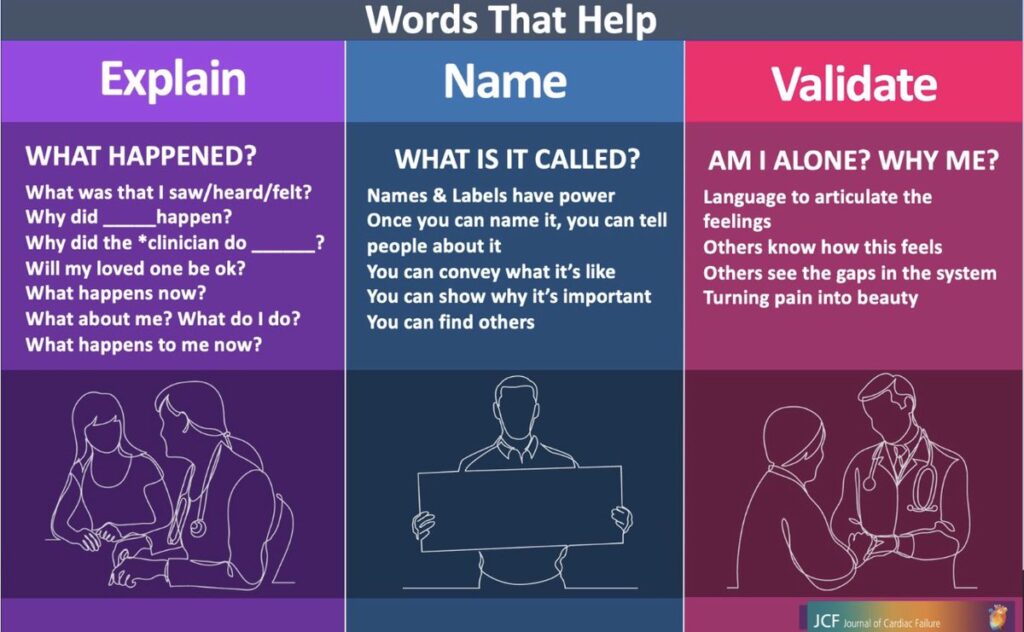
5. Explain, name, and validate their emotions and experiences.
Traumatic events may have preceded your interaction with the co-survivor. By naming them as such, you acknowledge that the experience is happening to them, too. Understand that co-survivors may experience various emotions, including fear, grief, anger, and guilt. Validate their feelings by acknowledging them and offering a safe space for expression. ❤️🩹
Flanary, Kristin. “Words to Leave By: Bridges Out of the Quiet Place.” Journal of Cardiac Failure 28.11 (2022): 1646-1648.
6. Encourage and help facilitate self-care.
Remind co-survivors to prioritize some self-care throughout the process. Encouraging them to rest, eat well, exercise, and engage in enjoyable activities can help them maintain their overall well-being. But remember that they may have a diminished capacity to care for themselves amidst everything they are dealing with, so you may need to go a step further and connect them with resources (see number 8). 💖
7. Connect them with support resources.
Share information about local support groups, counseling services, and online communities where co-survivors can connect with others who have faced similar journeys. Connecting with others can be profoundly healing.🤝
8. Be a compassionate listener.
Sometimes, all co-survivors need is someone to listen without judgment. Practice active listening, engage with empathy, and hold space for their stories and concerns.👂
9. Remember them at follow-up appointments.
The journey doesn’t end after major medical events. When you check in with co-survivors at follow-up appointments to see how they are faring, this simple gesture shows that you genuinely care about their well-being. 💙
10. Practice self-reflective learning.
You already are by being here! You get an A+ for seeking out resources, research, and personal narratives that provide insight into the unique perspective of co-survivors. 💫
Remember, small actions can make a significant difference for co-survivors. Integrating these tips into your practice can help co-survivors feel seen, heard, and supported during their loved one’s medical event.
RESOURCES
Heartsight: Understanding Cardiac Arrest: Here, you’ll find trusted resources carefully curated from clinical research and shared experiences of individuals who have experienced a Sudden Cardiac Arrest. There are resources for survivors, co-survivors, witnesses, bereaved, and healthcare professionals.
Susan G. Komen Co-survivor Resources: Here, you’ll find support and resources for co-survivors of breast cancer, which apply to being a co-survivor of any life-altering cancer diagnosis. The site offers information on co-survivors’ roles, varied ways of providing practical and emotional support, and co-survivor support networks.
1Trzeciak, Stephen, Anthony Mazzarelli, and Cory Booker. Compassionomics: The revolutionary scientific evidence that caring makes a difference. Pensacola, FL: Studer Group, 2019.
2Ely, Wes. Every deep-drawn breath: A critical care doctor on healing, recovery, and transforming medicine in the ICU. Simon and Schuster, 2022.
Share this post
Related Glauc Blog Co-Survivorship Posts
More of our musings on medical education and training,
Healthcare professionals often suffer in silence after a serious adverse patient event, but understanding the concept of the Second Victim is the first step toward healing. 💔
Weekly Roundups | Monthly Deep Dives | Real Healthcare Stories | No Spam | Good Jokes Only
Join 20,000+ others in our newsletter!
Promoting Humor & Humanity In Healthcare
Cookie Consent
Cookies and other tech tools help us personalize your visit, improve our marketing, and gather useful insights. By clicking 'Accept', you agree to the storing of cookies on your device. For more info, feel free to read our Privacy Policy
Contains information about the traffic source or campaign that directed user to the website. The cookie is set when the GA.js javascript is loaded and updated when data is sent to the Google Anaytics server
6 months after last activity
__utmv
Contains custom information set by the web developer via the _setCustomVar method in Google Analytics. This cookie is updated every time new data is sent to the Google Analytics server.
2 years after last activity
__utmx
Used to determine whether a user is included in an A / B or Multivariate test.
18 months
_ga
ID used to identify users
2 years
_gali
Used by Google Analytics to determine which links on a page are being clicked
30 seconds
_ga_
ID used to identify users
2 years
_gid
ID used to identify users for 24 hours after last activity
24 hours
_gat
Used to monitor number of Google Analytics server requests when using Google Tag Manager
1 minute
_gac_
Contains information related to marketing campaigns of the user. These are shared with Google AdWords / Google Ads when the Google Ads and Google Analytics accounts are linked together.
90 days
__utma
ID used to identify users and sessions
2 years after last activity
__utmt
Used to monitor number of Google Analytics server requests
10 minutes
__utmb
Used to distinguish new sessions and visits. This cookie is set when the GA.js javascript library is loaded and there is no existing __utmb cookie. The cookie is updated every time data is sent to the Google Analytics server.
30 minutes after last activity
__utmc
Used only with old Urchin versions of Google Analytics and not with GA.js. Was used to distinguish between new sessions and visits at the end of a session.