I never thought about cardiac arrest until it happened to us. But in May 2020, Will’s heart stopped in our bedroom. (0/10 would not recommend.)
Here’s what we hadn’t known:
- It doesn’t only happen to “older people” or “sick people.” Will was 34 and in perfect health. It can even happen to young kids and teens.
- It usually happens at home, not in public. Sure, someone can collapse while out and about. But over 70% of cardiac arrests take place at someone’s home.
- CPR can help, not hurt. If someone’s in cardiac arrest, stuff’s already bad. CPR may not make a difference in some cases, but it definitely won’t make things worse.
- Survivors may not remember it at all. Will had no idea what had happened to him. He also experienced amnesia for some time after.
- Co-survivors might not be able to forget. I experienced dissociative PTSD and relive moments like doing CPR just about every day, even now, six years afterward.
We’re lucky our story had a happy ending. As a friend joked, “Your husband is famously alive.”
Should everyone learn CPR?
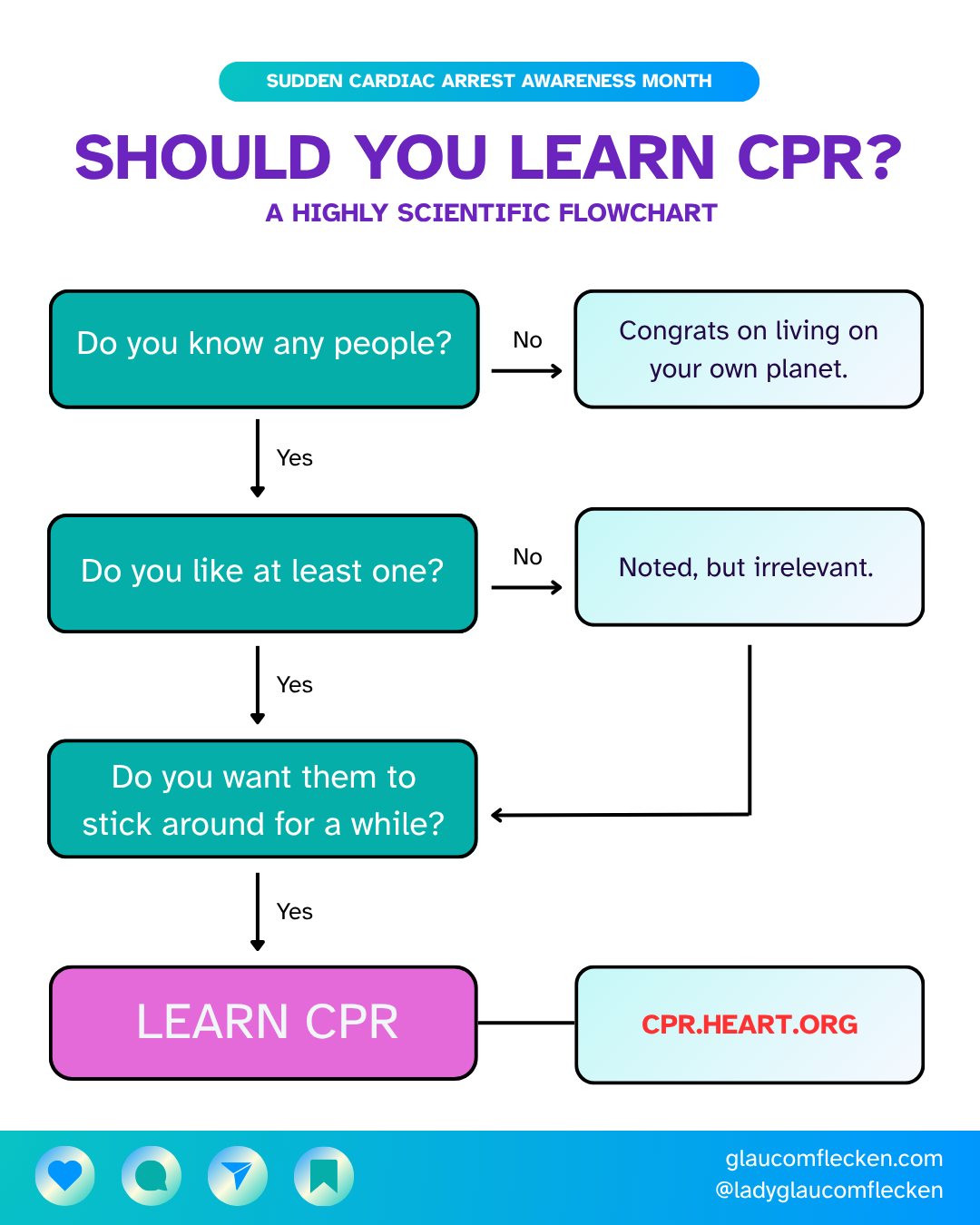
If someone you know isn’t sure, you should show them this chart.
Jokes aside, when Will experienced cardiac arrest, I didn’t even know he needed CPR. Thankfully, the 911 dispatcher, Lisa, walked me through every compression, and I did CPR for 10 minutes.
Here’s an uncomfy truth: Will never thought to make sure I knew CPR or BLS, because he assumed he’d be the one to step in for those things.
What he didn’t consider was that he might be the one who needed help. If you’re the trained one in your house, the people you live with are in the same spot I was.
Why some people hold back
You know CPR isn’t a guarantee, and there are some situations where it can’t make a difference. But for all the non-medical folks out there, it might help to know it can double or even triple the odds of survival, according to the American Heart Association.
So why do bystanders only do CPR in about 40% of situations?
Because they’re scared.
Bystanders want to help and often feel like they can’t. They’re scared of being sued, of not having the right qualifications, or of hurting the person and making things worse. Those are legitimate feelings.
What they may not know: every state has some version of a Good Samaritan law, which protects people who act in good faith to help someone.
So tell them to call 911 and start CPR if someone is unresponsive and not breathing (or breathing very oddly). They shouldn’t wait for help to arrive first.
One of the first signs of cardiac arrest
The horrific sound coming from Will woke me up at 4:45AM. It was unlike anything I’d ever heard before, something between loud snoring and panicked gasping. Sure, he snored sometimes, but this was different. Guttural, intense, and alarming.
You know it as agonal breathing. I didn’t, and many people don’t either. But Lisa recognized it over the phone right away.
The signs:
→ Shallow, jerky chest movements
→ Long pauses
→ Gurgling
→ Uneven rhythm
→ Gasping
The people you likely love and live with don’t have your training or expertise. Share this with them so they know what it sounds like and can recognize an emergency early.
They can learn CPR in 1 minute
Here’s another great resource you can share. The American Heart Association has a simple video at cpr.heart.org. Watching it once can help bystanders feel more prepared to jump in if they ever need to. No certification required.
And if they use it, they’ll need support after
People who perform CPR don’t just walk away and move on. They replay moments, feel guilt, and wonder what-if. Many professional responders go through this too, and there’s real stigma around admitting you’re struggling after saving someone’s life.
Shortly after I’d done ten minutes of CPR in the dark, a cardiologist recited the bleak survival statistics to me in the ER. He was trying to be helpful, but his approach missed what I needed in that moment.
What helped was Roger, an ICU nurse, who asked me, “How are YOU doing?”
You’re in a good position to be that person.
Something else that can help is OurHeartSight.com, built to support co-survivors, bystanders, and others impacted by cardiac arrest. I’m proud to have partnered with Resuscitation Council US to build the “I am a witness” section.
If you’re interested in learning more about supporting co-survivors, check out 3 resources that helped me process my trauma, what to say instead of “You should rest,” and how to actually help someone in a crisis.